
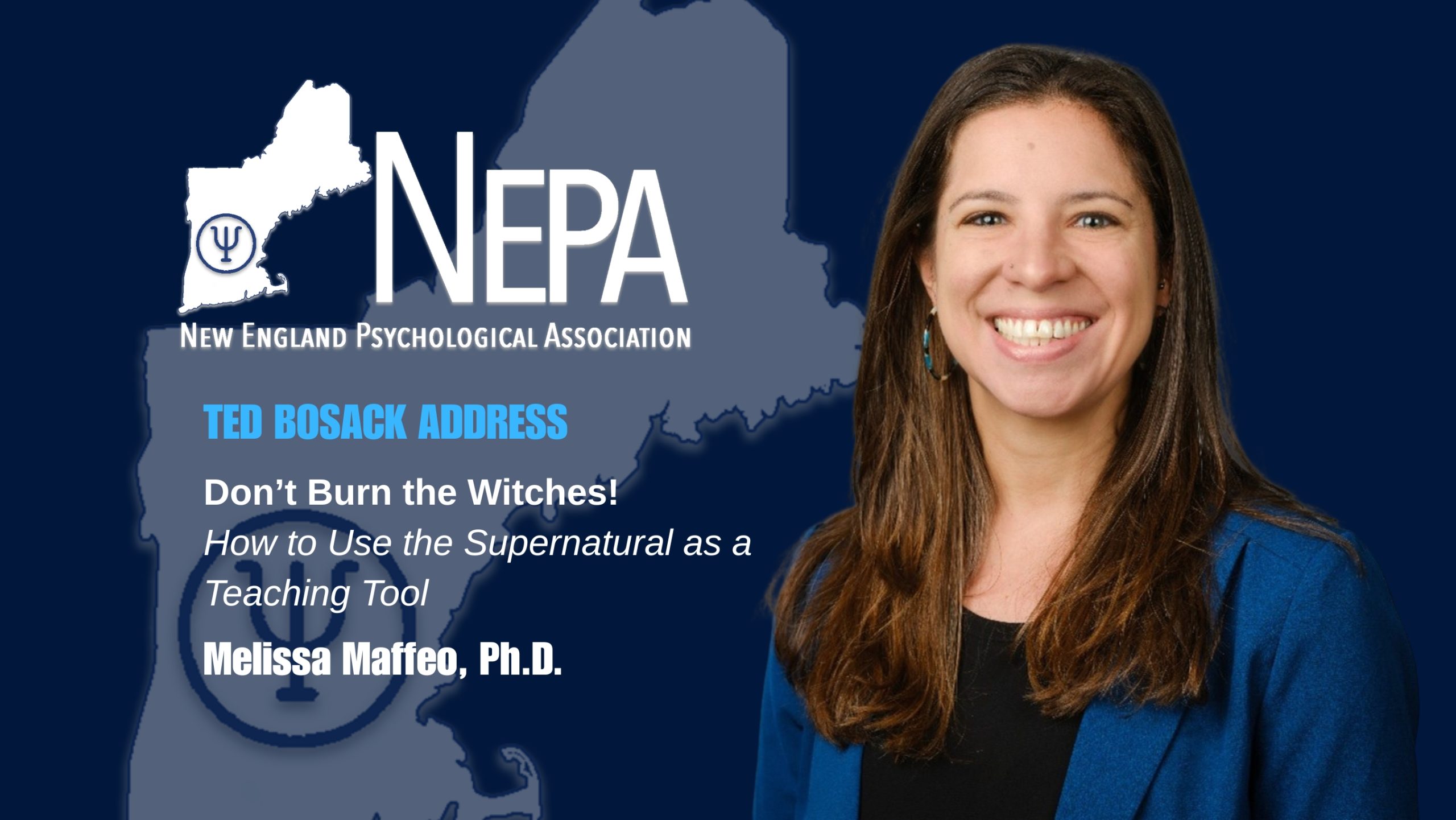
Don’t Burn the Witches! How to Use the Supernatural as a Teaching Tool
Melissa Maffeo, Ph.D.
Associate Teaching Professor
Associate Director, Program of Neuroscience
Wake Forest University
What do witch trials, ghosts, aliens, and psychics have to do with the teaching of psychology?
Quite a lot, actually.
About three in four Americans believe in some form of supernatural activity. This statistic leads to fascinating questions that can be raised in a psychology class. Are there psychological traits that cause some people to believe more than others? Are some people more sensitive to environmental stimuli? Are there factors that would cause one person to label an experience as supernatural while another labels it as ordinary? By using stories of things that go bump in the night, teachers of psychology can pique the curiosity of their students and leverage that curiosity to promote the skills and dispositions that underlie critical thinking.
Most supernatural occurrences can be explained by psychological science. As teachers, we can use the supernatural as a backdrop to teach important concepts in psychology – that science relies on empirical evidence, that psychology can explain principles of behavior while recognizing individual differences, and that our perceptions and biases filter our experiences. By exploring supernatural phenomena with the major subfields of psychology, students will gain content knowledge, learn to exercise scientific reasoning, develop interpersonal and intercultural responsiveness, and be more tolerant of ambiguity. In this talk, I will share easy-to-implement pedagogical strategies that utilize stories of the supernatural to teach students the importance and relevance of psychological science.
CONTACT
Association Coordinator’s
Mailing address:
Michael Amico, Ph.D.
Housatonic Community College
900 Lafayette Blvd
256 Beacon Hall
Bridgeport, CT 06604
NEPsychological@gmail.com
Phone: 203-362-5163
QUICK LINKS
PRIVACY POLICY
TERMS OF USE